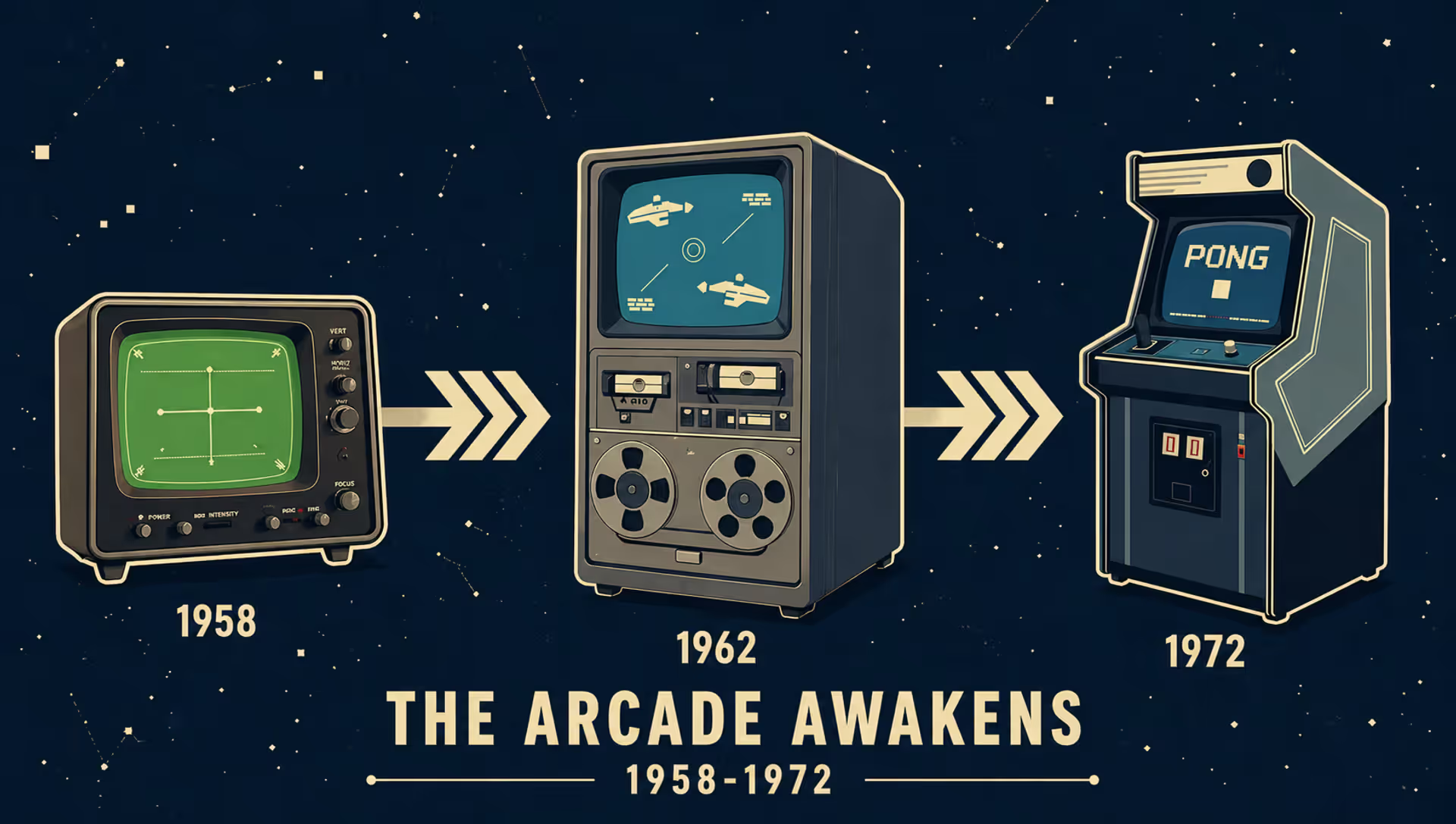
Retro-style collage showing evolution of early video games from 1950s oscilloscope to 1960s mainframe computer to 1970s arcade cabinet connected by a timeline
The question of when the first video game was made doesn't have a simple answer. Depending on how you define "video game," the answer shifts between 1958, 1962, or even 1972. The confusion stems from whether you're talking about electronic games, arcade games, home consoles, or commercial products. Each milestone represents a different breakthrough in interactive entertainment.
Understanding this history requires looking beyond marketing claims and examining what each pioneering effort contributed to gaming as we know it. Some games were technical demonstrations never meant for public play. Others launched industries but weren't technically "first." The debate continues among historians because the definition itself keeps evolving.
The Debate Over the First Video Game
The confusion around the first video game exists because different criteria produce different answers. If you define a video game as any interactive electronic entertainment displayed on a screen, Tennis for Two from 1958 claims the title. If you require the game to use a raster display (what we typically think of as a video screen), Spacewar! from 1962 wins. If commercial availability matters most, then Computer Space in 1971 or Pong in 1972 become the true pioneers.
Early gaming history explained through these distinctions reveals that innovation rarely happens in clean, linear steps. William Higinbotham created Tennis for Two as a visitor attraction at Brookhaven National Laboratory, never imagining it as a commercial product. Steve Russell and his colleagues at MIT built Spacewar! as a programming exercise to show off the capabilities of the PDP-1 computer. Ralph Baer developed his "Brown Box" prototype specifically to create a new consumer electronics category.
The definition problem goes deeper than semantics. Were these devices games if they weren't intended for entertainment? Does a game need to be sold to count? Must it use digital technology, or do analog circuits qualify? These questions matter because they determine which inventors receive credit and how we understand gaming's origins.
Most historians now acknowledge multiple "firsts" rather than arguing for one definitive answer. This approach recognizes that different innovations contributed essential elements to what became the video game industry.
Early Electronic Games Before Commercial Success
Tennis for Two (1958)
Physicist William Higinbotham created Tennis for Two in October 1958 at Brookhaven National Laboratory in Upton, New York. He designed it to make the laboratory's annual public exhibition more engaging for visitors. The game displayed on an oscilloscope, showing a side view of a tennis court with a net. Players used controllers with buttons and knobs to hit a ball back and forth, with gravity affecting the ball's trajectory.
The display measured only five inches in diameter, but the gameplay was surprisingly sophisticated. The analog computer calculated ball physics in real time, creating a genuinely interactive experience. Visitors lined up for hours to play during the 1958 and 1959 exhibitions. Despite this popularity, Higinbotham never patented the invention and dismantled it after the second year. He considered it a minor project compared to his other work.
Tennis for Two never reached beyond those laboratory demonstrations. No commercial entity saw its potential, and Higinbotham himself didn't pursue development. The game remained forgotten until the 1980s when historians began documenting gaming's origins.
Author: Megan Crosley;
Source: canelomobile.com
Spacewar! (1962)
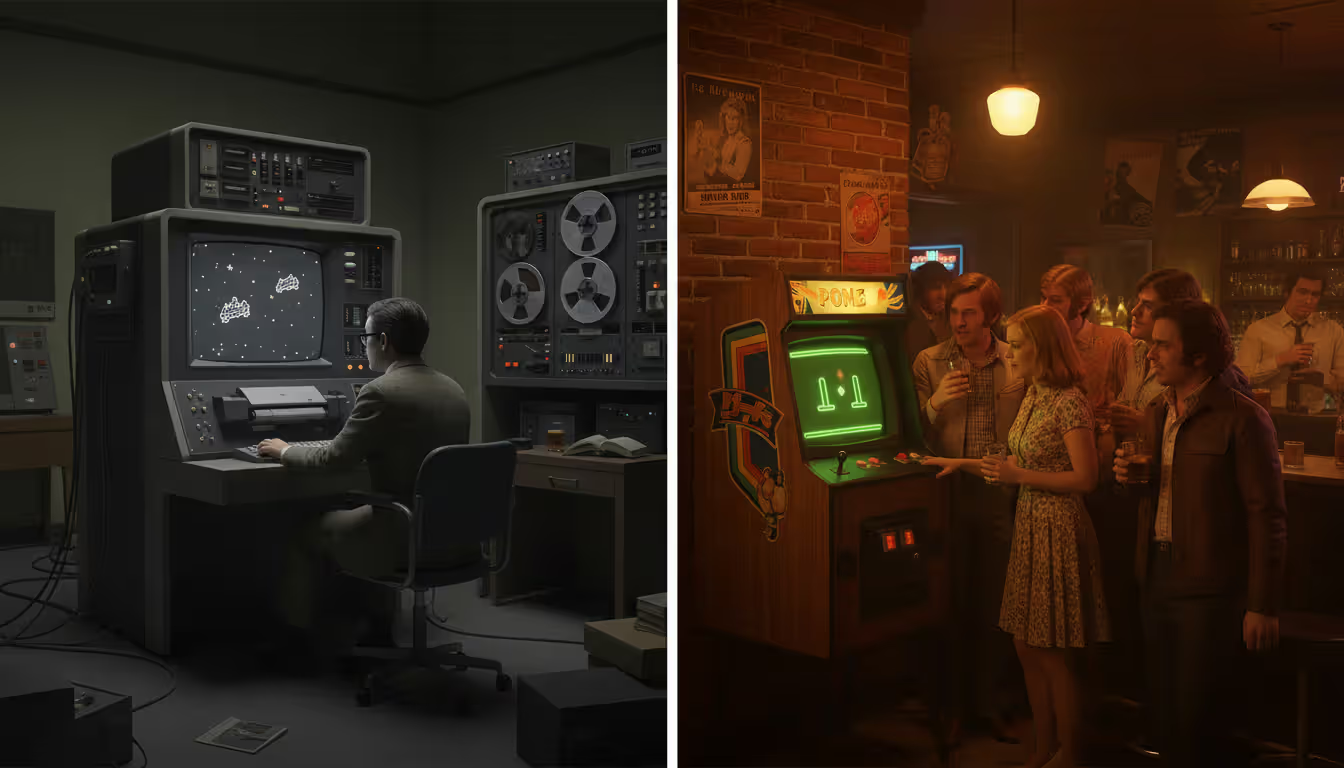
Steve Russell, a programmer at MIT, created Spacewar! in 1962 on the DEC PDP-1 computer. The game featured two spaceships battling around a star's gravitational field. Each player controlled rotation, thrust, and torpedoes while managing limited fuel. The star in the center pulled both ships toward it, creating strategic depth as players balanced aggression with survival.
Russell and his colleagues spent about 200 hours programming the game, adding features like a starfield background and a hyperspace escape button (which teleported your ship randomly and could backfire). The PDP-1 cost $120,000, making it accessible only to universities and research institutions. However, DEC began including Spacewar! as a diagnostic program on new PDP-1 computers, spreading it across academic institutions.
Spacewar origins trace to science fiction fandom—Russell belonged to the Tech Model Railroad Club at MIT, a group that loved both technology and sci-fi novels. The game's combat borrowed concepts from E.E. "Doc" Smith's Lensman series. This connection between gaming and science fiction culture would influence game design for decades.
The game never generated revenue directly, but its influence was enormous. Nolan Bushnell played Spacewar! at the University of Utah and later adapted its concepts for Computer Space, his first commercial venture.
The Magnavox Odyssey (1972)
Ralph Baer began developing home video game technology in 1966 while working at Sanders Associates, a defense contractor. His "Brown Box" prototype evolved through several iterations before Magnavox licensed the technology. The Magnavox Odyssey launched in September 1972 as the first commercial home video game console.
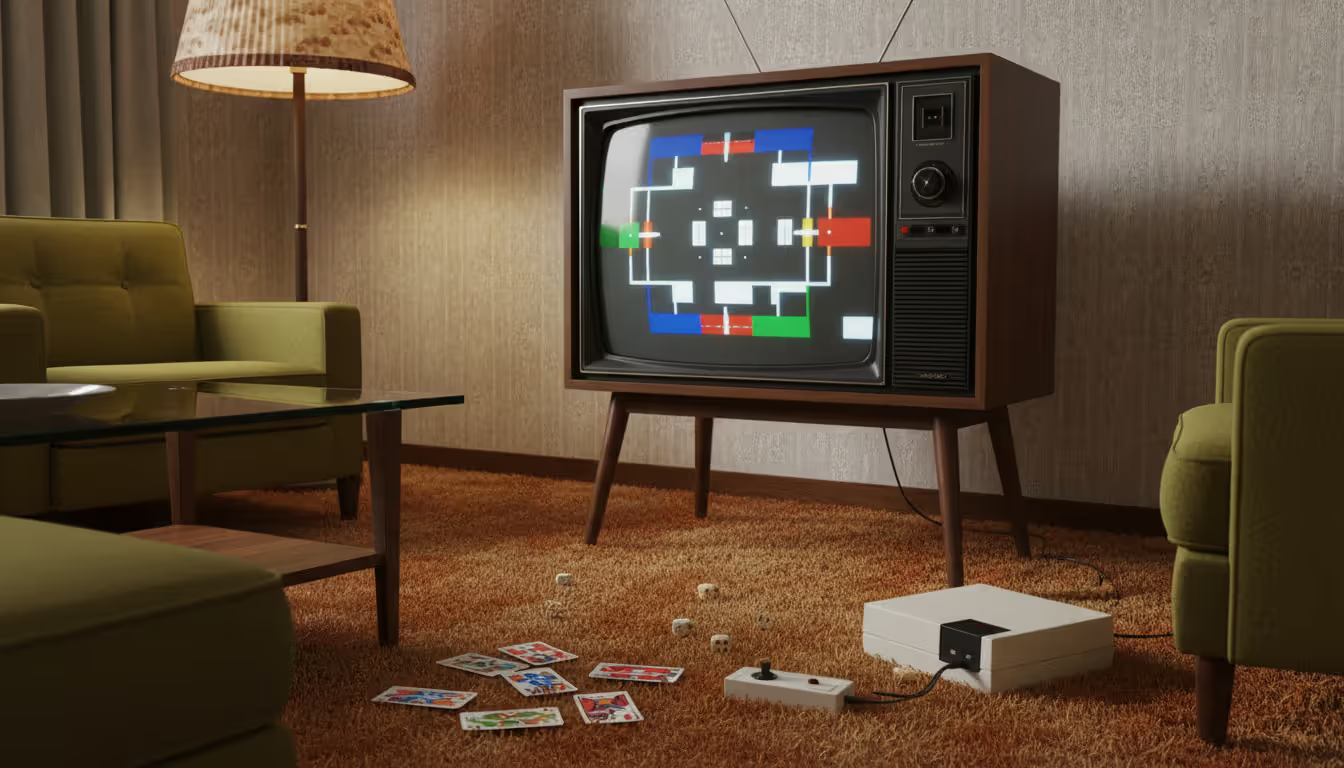
The Odyssey didn't generate its graphics electronically in the modern sense. Instead, it produced simple white squares and lines on the screen. Players added plastic overlays to their television screens to create different game environments—tennis courts, haunted houses, football fields. The system came with dice, cards, and game boards, blending electronic and traditional gameplay.
Magnavox sold roughly 350,000 units by the time they discontinued the original Odyssey in 1975. Sales suffered partly because Magnavox's marketing suggested the console only worked with Magnavox televisions, which wasn't true. The company also sold the system primarily through their own retail stores rather than broader distribution channels.
Despite modest commercial success, the Odyssey established the home console concept. Baer's patents became the foundation for the entire industry, leading to licensing agreements and lawsuits that shaped gaming's business landscape through the 1980s.
Author: Megan Crosley;
Source: canelomobile.com
Who Invented Video Games
Identifying video game inventors requires acknowledging that several people independently contributed essential innovations.
William Higinbotham (1910-1994) created Tennis for Two but never pursued gaming further. He spent most of his career on nuclear nonproliferation efforts, having worked on the Manhattan Project during World War II. He later said his greatest accomplishment was founding the Federation of American Scientists, not inventing video games. Higinbotham only received recognition as a gaming pioneer decades after his 1958 demonstration.
Steve Russell (born 1937) programmed Spacewar! while at MIT and continued working in computer science throughout his career. He never profited from Spacewar! directly but became a respected figure in computing history. Russell worked on early time-sharing systems and later joined the computer science faculty at the University of California, Santa Cruz. His collaborative approach to Spacewar!'s development reflected the academic culture of sharing and improving code.
Ralph Baer (1922-2014) earned the title "Father of Video Games" through his persistent vision of bringing interactive entertainment into homes. Unlike Higinbotham or Russell, Baer specifically intended to create a commercial product. He filed the first television gaming patents and fought legal battles to protect his inventions. Baer received the National Medal of Technology in 2006 and continued inventing games and toys until his death. His notebooks and prototypes are now preserved at the Smithsonian.
Nolan Bushnell (born 1943) founded Atari and brought video games to mainstream audiences. While he didn't invent the underlying technology, Bushnell understood how to make games commercially viable. He recognized that games needed to be simple enough for anyone to play within seconds but engaging enough to keep players feeding in quarters. This design philosophy shaped arcade gaming's golden age. Bushnell's entrepreneurial approach transformed gaming from a curiosity into an industry.
Pong vs Spacewar Origins Explained
The confusion between Pong and Spacewar! represents one of gaming history's most common misconceptions. Spacewar! came first, created in 1962, while Pong didn't appear until 1972—a full decade later. Yet many people remember Pong as the original video game. This perception gap reveals how commercial success shapes historical memory.
Spacewar! remained confined to expensive computers in universities and research labs. The PDP-1 computers that ran it cost more than most houses. Only students, researchers, and engineers ever played it. The game's complexity also presented barriers—controlling a spaceship with multiple buttons while managing fuel and gravity required practice and patience.
Pong succeeded because of its accessibility. Anyone could understand "avoid missing ball for high score" within seconds. The game required only one knob per player. Bushnell and his partner Ted Dabney installed the first Pong prototype at Andy Capp's Tavern in Sunnyvale, California, in September 1972. Within days, the machine stopped working—not from technical failure, but because the coin box was overflowing.
Atari manufactured Pong cabinets by the thousands, placing them in bars, bowling alleys, and pizza parlors across America. By 1974, dozens of companies were producing Pong clones. The game became synonymous with video gaming itself, appearing in news stories and pop culture. Spacewar! remained an insider's reference, known primarily to computer enthusiasts.
The legal relationship between the games adds another layer. Bushnell's first commercial game, Computer Space (1971), directly adapted Spacewar!'s mechanics. When that game failed commercially due to complexity, Bushnell simplified his approach, leading to Pong. So while Pong wasn't technically derived from Spacewar!, both came from the same creative lineage through Bushnell's experience.
Author: Megan Crosley;
Source: canelomobile.com
The First Commercial Video Game
Computer Space holds the distinction of being the first commercially sold video game, manufactured by Nutting Associates and released in November 1971. Nolan Bushnell and Ted Dabney designed the game, which was essentially a coin-operated version of Spacewar!. The futuristic fiberglass cabinet became iconic, even appearing in the 1973 science fiction film "Soylent Green."
Computer Space failed commercially despite its historical importance. Nutting produced about 1,500 units, but most didn't generate enough revenue to justify their arcade space. The game required players to understand concepts like inertia and momentum. Bar patrons, often playing while drinking, found it frustrating. Bushnell later admitted he had designed the game for himself and his engineering friends rather than the general public.
How gaming began as a commercial industry really traces to Pong's success in 1972. After leaving Nutting Associates, Bushnell founded Atari with Ted Dabney. They designed Pong to be dramatically simpler than Computer Space. The game used discrete logic circuits rather than a microprocessor, keeping production costs manageable. Atari initially built machines in an abandoned roller rink, with Bushnell's daughter helping to assemble components.
Pong's commercial impact was immediate and enormous. Atari sold over 8,000 Pong machines in the first year. Competitors flooded the market with imitations, creating the first video game boom. The game generated so much revenue that it attracted organized crime's attention—some arcade operators found themselves dealing with mob-controlled distribution networks.
The Magnavox Odyssey represents the first commercial video game in the home console category. While Computer Space and Pong targeted arcades, the Odyssey aimed at families. Magnavox's retail price of $99.95 (equivalent to about $700 in 2026 dollars) positioned it as a significant purchase. The company marketed it alongside their television sets, treating it as a premium entertainment option.
Interestingly, Ralph Baer had demonstrated a ping-pong game on his Brown Box prototype before Pong's release. When Bushnell saw the Odyssey demonstrated in May 1972, he was already developing Pong, but the timing led to a lawsuit. Magnavox sued Atari and dozens of other companies for patent infringement. Atari eventually settled, becoming a Magnavox licensee. These legal battles established that Baer's patents covered fundamental aspects of video game technology.
Author: Megan Crosley;
Source: canelomobile.com
Timeline of Early Gaming Milestones
Understanding the history of video games timeline requires seeing how innovations built upon each other:
1958 - William Higinbotham demonstrates Tennis for Two at Brookhaven National Laboratory. The analog computer game runs for two years before being dismantled.
1962 - Steve Russell and colleagues at MIT create Spacewar! on the PDP-1 computer. The game spreads to other institutions as DEC uses it to demonstrate their computers.
1966 - Ralph Baer writes a four-page document outlining his vision for home video game systems. Sanders Associates funds his research, leading to the Brown Box prototypes.
1967 - Baer's team creates the first video game prototype that works on a standard television set. They develop several game concepts including chase games and light gun games.
1968 - Baer demonstrates the Brown Box to television manufacturers. Most show little interest, but Magnavox eventually licenses the technology.
1971 - Computer Space, created by Nolan Bushnell and Ted Dabney, becomes the first commercially sold coin-operated video game. Galaxy Game, another Spacewar! adaptation, also appears but only as a one-off prototype at Stanford University.
1972 - Magnavox releases the Odyssey home console in September. Atari releases Pong in November, creating the first commercially successful arcade game. Both events happen within two months, marking the true beginning of the video game industry.
1975 - Atari releases a home version of Pong, sold exclusively through Sears. The game becomes that year's hot Christmas item, validating the home gaming market.
1976 - Fairchild releases the Channel F, the first home console to use ROM cartridges for game storage. This innovation allows players to build game libraries rather than being limited to built-in games.
1977 - Atari releases the Video Computer System (later known as the Atari 2600), which becomes the dominant home console platform. The cartridge-based system eventually hosts hundreds of games.
1978 - Space Invaders launches in Japan, created by Tomohiro Nishikado for Taito. The game becomes a cultural phenomenon and drives arcade revenue to unprecedented levels.
1980 - Pac-Man debuts, becoming the most commercially successful arcade game to that point. Namco's creation appeals to demographics beyond the young males who dominated arcade culture, expanding gaming's audience significantly.
There is no single 'first' video game. The answer depends entirely on your definition. If you mean the first interactive electronic game displayed on a screen, that's Tennis for Two. If you mean the first game on a computer with a proper display, that's Spacewar!. If you mean the first commercial product, you have to choose between arcade and home systems. History is rarely as clean as we'd like it to be
— Ralph Baer
Frequently Asked Questions About Early Video Game History
What is considered the very first video game ever made?
Tennis for Two, created by William Higinbotham in 1958, is generally considered the first video game if you define the term broadly as interactive electronic entertainment displayed on a screen. However, some historians argue for earlier devices like the Cathode Ray Tube Amusement Device patented in 1947, which was a missile simulator rather than a game in the entertainment sense. The answer depends on whether you prioritize date, technology type, or commercial intent.
Was Pong really the first video game?
No. Pong was the first commercially successful video game, but not the first video game overall. It was released in 1972, ten years after Spacewar! and fourteen years after Tennis for Two. Pong's fame comes from its accessibility and commercial impact rather than chronological priority. The game became synonymous with video gaming for millions of people who encountered it in public spaces, which explains why many remember it as "first."
Who is the father of video games?
Ralph Baer earned this title through his pioneering work on home console technology. He specifically set out to create a commercial video game product in 1966 and followed through with patents, prototypes, and licensing deals. While Higinbotham and Russell created earlier games, neither pursued gaming as an industry. Baer's vision, persistence, and legal protections established the foundation for home gaming as a business. The National Medal of Technology he received in 2006 officially recognized this contribution.
What was the first video game sold to the public?
Computer Space, released in November 1971, was the first arcade video game sold to the public. For home systems, the Magnavox Odyssey, released in September 1972, was the first console available for purchase. If you're asking about the first successful commercial game, Pong (November 1972) dominated arcades while the home version of Pong (1975) became the first hit home gaming product.
Why did Spacewar never become commercial?
Spacewar! remained non-commercial because it required a $120,000 computer to run. In 1962, no viable path existed to make such technology affordable for arcades or homes. The game also emerged from academic culture where sharing and improving code mattered more than profit. By the time technology advanced enough to make commercial versions possible, Nolan Bushnell attempted it with Computer Space in 1971, but the gameplay proved too complex for mainstream audiences. Spacewar!'s legacy lived on through its influence rather than direct commercial success.
What came first, arcade games or home consoles?
This depends on how you count. Computer Space (1971) reached arcades before the Magnavox Odyssey (1972) reached homes, but only by about ten months. However, Ralph Baer began developing home console technology in 1966, years before anyone pursued commercial arcade games. The technologies developed in parallel, with Baer working on home systems while Bushnell adapted existing games for coin-operated machines. Both markets emerged nearly simultaneously in 1971-1972, creating the video game industry as we know it.
The question "when was the first video game made" opens a window into how innovation actually happens—messily, simultaneously, and with multiple valid answers depending on your criteria. Tennis for Two demonstrated interactive electronic entertainment in 1958. Spacewar! proved games could be compelling enough that people would line up to play them in 1962. The Magnavox Odyssey brought gaming into homes in 1972. Pong made gaming profitable that same year.
Each milestone contributed something essential. Higinbotham showed that electronic games could be intuitive and fun. Russell demonstrated that games could create communities of players. Baer proved that games could be consumer products. Bushnell figured out how to make games into a sustainable business.
The pioneers came from different backgrounds—physics, computer science, electrical engineering, entrepreneurship—and none initially set out to create an industry. Their inventions emerged from curiosity, technical challenges, and occasional accidents. The video game industry exists because these separate threads eventually wove together.
For anyone researching gaming history, the lesson is clear: resist simple origin stories. The first video game was made in 1958, 1962, 1971, and 1972, depending on what you're measuring. Understanding this complexity provides a richer appreciation for how transformative technologies develop. Gaming didn't spring fully formed from one inventor's vision—it accumulated through decades of experimentation, failure, and gradual refinement.
Crypto gaming merges blockchain with video games, letting players own assets as NFTs and earn cryptocurrency. Learn how blockchain technology powers games, the rise and fall of play-to-earn, types of crypto games, pros and cons, and whether they're worth your time in 2026
AFK stands for Away From Keyboard—a gaming term indicating a player has stepped away from their device. Understanding AFK meaning in games helps you avoid penalties, respect teammates, and navigate multiplayer etiquette across MOBAs, FPS games, and MMOs
Meta refers to the most effective strategies, characters, and tactics dominating competitive play. Understanding gaming meta isn't just jargon—it's the invisible rulebook shaping how millions play, compete, and win across League of Legends, Valorant, Overwatch, and other competitive titles
Understand how video games receive age ratings, what ESRB symbols mean (E, T, M), how games are evaluated, content descriptors, PEGI vs ESRB differences, and why ratings matter for parents and gamers making informed choices
The content on this website is provided for general informational and educational purposes only. It is intended to explain concepts related to video games, gaming guides, builds, mobile gaming, multiplayer strategies, and gaming history.
All information on this website, including articles, guides, and examples, is presented for general educational and entertainment purposes. Gameplay outcomes, strategies, and performance may vary depending on player skill, game updates, and platform.
This website does not provide professional advice or guarantee game outcomes, and the information presented should not be used as a substitute for official game documentation or developer guidance.
The website and its authors are not responsible for any errors or omissions, or for any outcomes resulting from decisions made based on the information provided on this website.