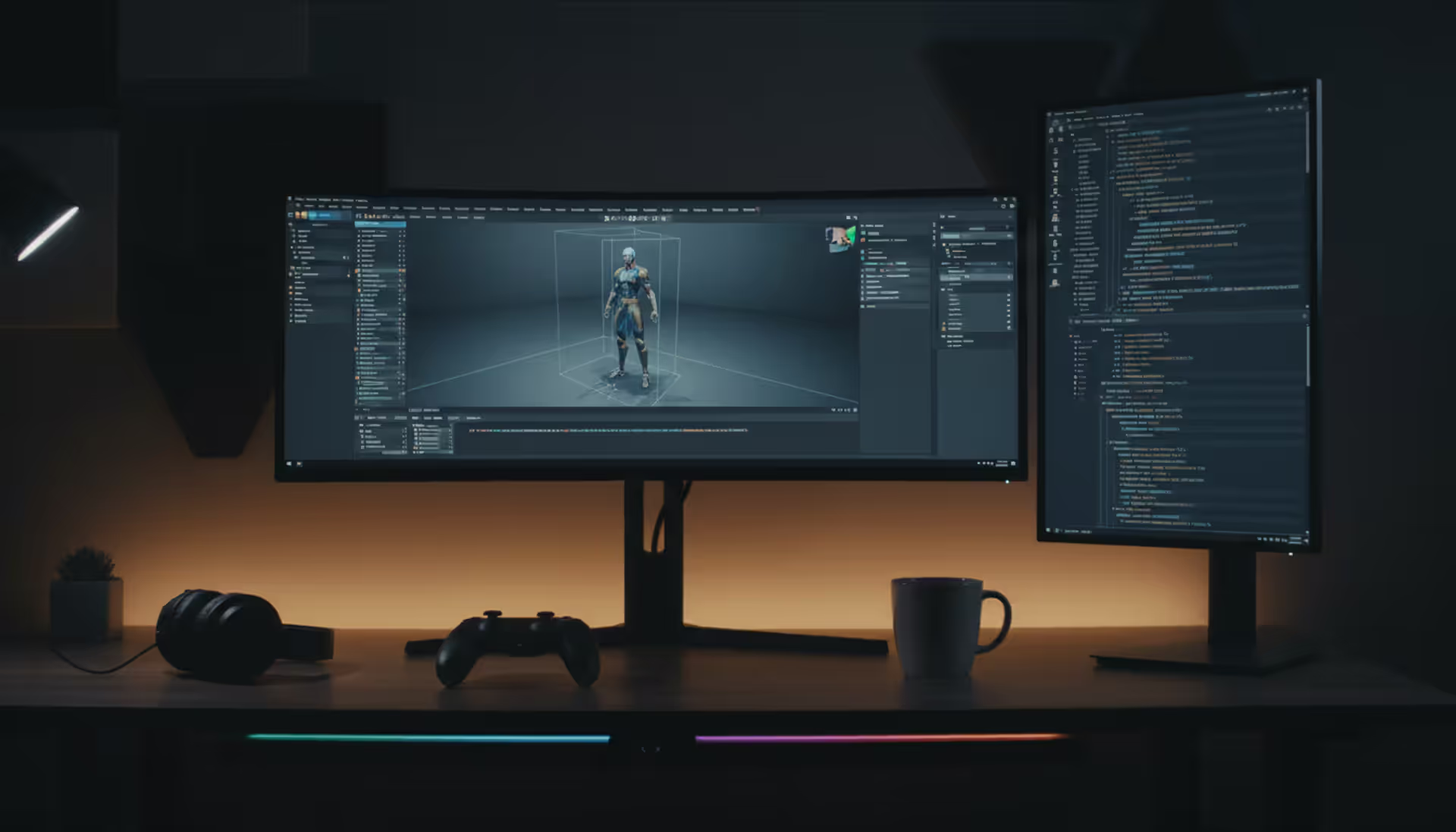
Game developer workspace with a widescreen monitor displaying a 3D game engine scene and a second monitor showing programming code, headphones and a gamepad on the desk
A game developer is a software engineer who writes code to create video games. Unlike designers who plan gameplay or artists who create visuals, developers build the technical systems that make games run—from character movement and physics to AI behavior and online multiplayer functionality.
The role varies dramatically depending on studio size, project scope, and specialization. A solo indie developer might handle everything from coding to sound design, while a developer at a major studio typically focuses on one system, such as rendering pipelines or network architecture. Understanding these distinctions helps anyone considering this career path set realistic expectations and choose the right entry point.
What Game Developers Actually Do on a Daily Basis
Most developers spend 60–70% of their time writing and debugging code. A gameplay programmer might implement a new enemy attack pattern, test it in the engine, discover the animation doesn't sync properly with the hitbox, then spend two hours tracing why the timing offset occurs. This cycle of implementation, testing, and refinement repeats constantly.
Collaboration takes up another 20–30% of the day. Morning standups review what each team member accomplished yesterday and plans for today. A developer working on inventory systems might meet with UI designers to discuss how item tooltips should display, then check with artists about memory budgets for item icons. Later, they'll review a pull request from another programmer who modified shared code, ensuring the changes don't break existing features.
Prototyping new mechanics happens during dedicated sprint time. A developer might spend a week building a rough version of a grappling hook system to see if it feels fun, using placeholder art and simplified physics. If the team approves, they'll spend the next month refining it—adding edge cases like what happens when players grapple mid-jump, optimizing performance, and integrating proper animations.
Debugging consumes more time than newcomers expect. A crash that only occurs when specific conditions align—say, saving the game while a certain enemy type is mid-attack during a weather transition—can take days to reproduce and fix. Developers use logging tools, debuggers, and sometimes just print statements to track down where systems fail.
Documentation and code reviews round out the day. Writing clear comments explaining why a particular solution was chosen helps future team members (or yourself six months later) understand the codebase. Reviewing others' code catches bugs early and maintains consistent coding standards across the project.
Author: Jordan Kessler;
Source: canelomobile.com
Different Types of Game Developer Roles and Responsibilities
Game development encompasses several specialized roles, each requiring different technical skills and mindsets. The two broadest categories—indie and AAA—operate under fundamentally different constraints.
Indie Game Developer Explained
Indie developers typically work in teams of one to fifteen people, often wearing multiple hats. A programmer might also handle game design decisions, write dialogue, or even create simple art assets. This generalist approach offers creative freedom but demands broad competency.
Budget constraints force pragmatic tool choices. Most indie teams use Unity or Godot rather than building custom engines, relying on asset stores for music, sound effects, and placeholder art. Development cycles range from three months for a small puzzle game to three years for an ambitious RPG, with many projects funded through personal savings, day jobs, or crowdfunding.
The work schedule fluctuates wildly. Months of steady 40-hour weeks might precede a pre-launch crunch where 60-hour weeks become normal. Job security depends entirely on whether games succeed commercially—a reality that makes many indie developers maintain freelance work or part-time employment alongside their projects.
Successful indie developers master scope management. They ruthlessly cut features that don't serve the core experience, knowing a polished small game outperforms a buggy ambitious one. They also handle business tasks: marketing, community management, publisher negotiations, and platform certification requirements.
AAA Game Developer Differences
AAA studios employ hundreds of developers, each specializing narrowly. An engine programmer optimizes rendering performance, a gameplay programmer implements combat mechanics, a tools programmer builds editor features that help designers work faster, and a network programmer handles multiplayer infrastructure. This specialization enables technical depth but limits creative input on the overall game direction.
Budgets reach $50–200 million, funding motion capture studios, orchestral soundtracks, and years of development time. Teams use proprietary engines like Unreal Engine with heavy customization, and developers often spend months just learning the studio's specific toolchain and coding standards before contributing meaningfully.
Work schedules at AAA studios have improved since the 2000s, with many studios targeting 40-hour weeks outside of occasional crunch periods before major milestones. Job security depends on project success and studio ownership—a poorly received game can lead to layoffs, while successful franchises provide stable employment for years.
Career advancement follows clearer paths than in indie development. Junior developers receive mentorship, mid-level developers own entire systems, seniors architect major features, leads manage teams, and directors oversee multiple projects. This structure provides growth opportunities but requires patience—promotions typically take 2–3 years at each level.
Aspect
Indie Developer
AAA Developer
Team Size
1–15 people
100–500+ people
Budget
$10K–$500K
$50M–$200M+
Creative Control
High; direct input on all decisions
Low; focused on assigned systems
Tools/Engines
Unity, Godot, GameMaker
Unreal Engine, proprietary engines
Work Schedule
Variable; heavy crunch before launch
More stable; occasional crunch
Job Security
Low; depends on game sales
Moderate; depends on studio stability
Salary Range
$0–$80K (often profit-share)
$65K–$180K+ (salary-based)
Project Duration
3 months–3 years
2–5 years
How to Become a Game Developer in the US
The traditional path involves earning a computer science degree, which provides strong fundamentals in algorithms, data structures, and software engineering principles. Universities like USC, DigiPen, and Carnegie Mellon offer game-specific programs, but a standard CS degree from any accredited institution suffices. Employers care more about what you can build than where you studied.
Self-taught developers succeed by treating learning like a full-time job. They work through structured resources like "Game Programming Patterns" by Robert Nystrom, complete Unity or Unreal tutorials, and reverse-engineer simple games to understand how mechanics work. The key difference between hobbyists and professionals is finishing projects—even small ones—rather than endlessly starting new ideas.
Author: Jordan Kessler;
Source: canelomobile.com
Coding bootcamps have expanded into game development, offering 12–16 week intensive programs. These work best for career changers who already have some programming experience and need structured guidance to transition into games specifically. Bootcamps cost $10K–$20K but provide networking opportunities and portfolio feedback that accelerate job searches.
Portfolio building separates successful applicants from the hundreds of others applying to entry-level positions. Three polished small games demonstrate more competence than one ambitious unfinished project. Employers want to see clean code on GitHub, playable builds, and short documentation explaining technical challenges you solved. A tower defense game where you implemented A* pathfinding and optimized it to handle 200 enemies at 60fps tells a better story than a sprawling RPG with broken combat.
First job strategies differ by target. Indie studios value generalists who can ship features independently, so highlight complete projects you've built solo. AAA studios want specialists who collaborate well, so emphasize contributions to team projects, code reviews you've participated in, and familiarity with version control and agile workflows. QA testing positions offer another entry point—many developers start testing games, learn the studio's tools, and transition internally.
Networking matters more than most beginners realize. Attending GDC (Game Developers Conference), local IGDA chapters, or game jams puts you in rooms with hiring managers and team leads. A 15-minute conversation about your tower defense pathfinding solution can lead to an interview that a cold resume submission never would.
Game Developer Career Path and Advancement Opportunities
Entry-level developers (0–2 years) implement features designed by others. A junior might add a new weapon type to a shooter, following detailed specifications about damage values, fire rate, and reload behavior. They receive frequent code reviews, pair program with seniors, and gradually learn the codebase's architecture. Salaries range from $65K–$85K depending on location and studio size.
Mid-level developers (2–5 years) own entire systems. They might architect the inventory system for an RPG, making decisions about data structures, save/load implementation, and how it interfaces with other systems. They mentor juniors, participate in design discussions, and debug complex issues that span multiple systems. Salaries increase to $85K–$120K, with bonuses and profit-sharing at some studios.
Senior developers (5–10 years) tackle the hardest technical problems. They optimize rendering pipelines to hit performance targets, architect networking solutions for 100-player matches, or build tools that make the entire team more productive. They set coding standards, conduct technical interviews, and often specialize deeply—becoming the "rendering expert" or "AI specialist" the team relies on. Compensation reaches $120K–$160K.
Lead developers (8–12 years) manage teams of 5–15 developers while still contributing code. They break down large features into tasks, assign work based on team members' strengths, and ensure technical decisions align with project goals. Leads balance engineering excellence with schedule reality, sometimes advocating for technical debt paydown or pushing back on feature requests that would destabilize the codebase. Pay ranges from $140K–$180K.
Technical directors (10+ years) oversee engineering across entire projects or multiple teams. They make high-level architectural decisions—choosing between building custom tech versus licensing middleware, planning multi-year engine upgrades, or establishing studio-wide best practices. Directors spend more time in meetings than writing code, but their technical expertise informs every major decision. Salaries exceed $180K, often reaching $250K+ with bonuses at major studios.
Specialization options branch throughout this progression. Gameplay programmers focus on mechanics and feel, engine programmers optimize core systems, tools programmers build editor features, graphics programmers implement rendering techniques, and network programmers handle multiplayer infrastructure. Choosing a specialization usually happens at the mid-level stage, based on both interest and market demand.
Famous Game Developers History and What Made Them Successful
Shigeru Miyamoto entered Nintendo in 1977 as an artist but taught himself programming to create Donkey Kong. His career lesson: don't let job titles limit what you learn. When Nintendo needed someone to design a game, Miyamoto volunteered despite lacking formal game design training. He studied the technical constraints of arcade hardware, then designed within those limits rather than fighting them. This pragmatic creativity—understanding what's possible before designing what's ideal—defined his approach to Mario, Zelda, and decades of successful games.
John Carmack's path demonstrates the power of deep specialization. While working at Softdisk in the early 1990s, he obsessed over 3D rendering techniques, implementing algorithms from academic papers and optimizing them for consumer hardware. His breakthrough came from recognizing that PCs could handle texture-mapped 3D graphics if you cleverly exploited hardware limitations. Wolfenstein 3D and Doom didn't just succeed commercially—they advanced what developers thought possible on the platform. Carmack's lesson: mastering fundamentals deeply enough to push boundaries creates opportunities that following trends never will.
Hideo Kojima started at Konami in 1986, initially assigned to MSX games despite wanting to make action titles. Rather than resent the limitation, he designed Metal Gear around the MSX's constraints—since the hardware couldn't handle many on-screen enemies, he made stealth the core mechanic. His career shows how constraints breed innovation. Later, as a director, Kojima advocated for cinematic storytelling in games when most developers prioritized gameplay over narrative. His willingness to champion unpopular ideas—and execute them well enough to prove skeptics wrong—built his reputation.
Author: Jordan Kessler;
Source: canelomobile.com
Amy Hennig began as an artist at Crystal Dynamics before transitioning to design and writing. Her work on Legacy of Kain demonstrated strong narrative craft, which led to her directing the Uncharted series at Naughty Dog. Hennig's path illustrates that game development careers rarely follow straight lines. Her artistic background informed her directing style—she understood how visual storytelling, animation timing, and environmental design reinforced narrative beats. The lesson: diverse skills compound in unexpected ways. A developer who understands art pipelines communicates better with artists; one who's written dialogue designs better quest systems.
These developers share common traits beyond talent. They finished projects even when scope expanded or motivation waned. They learned adjacent disciplines—programming, design, art—enough to collaborate effectively. They took creative risks on projects where others played safe. And they built reputations for reliability, so when they pitched ambitious ideas, teams trusted them to deliver.
The most important thing is to actually finish something. Success is finishing. Publishing is the side effect
— John Romero
Common Mistakes When Starting a Game Developer Career
Scope creep destroys more first projects than bad code. Beginners envision open-world RPGs with branching storylines, crafting systems, and dynamic weather, then spend two years building 10% of that vision before burning out. The fix: make your first game embarrassingly small. A polished one-screen puzzle game or a five-minute platformer teaches more than an abandoned epic. Each finished project builds confidence and reveals what you enjoy creating.
Ignoring networking keeps talented developers undiscovered. Many assume good work speaks for itself, but hiring managers never see portfolios they don't know exist. Attending local game dev meetups feels awkward initially, but the developer who helps debug someone's pathfinding problem at a game jam might later refer them for a job opening. Online communities like the Game Dev League Discord or r/gamedev subreddit provide networking opportunities without travel costs. Comment thoughtfully on others' projects, share your own progress, and offer help when you can.
Portfolio errors signal inexperience even when skills are solid. Posting only source code without playable builds makes employers work to evaluate you—most won't bother. Including unfinished projects suggests you don't ship. Failing to document what you built and why forces reviewers to guess at your contributions. The fix: for each portfolio piece, provide a playable web build or video, a one-paragraph description of the technical challenge you solved, and a GitHub link to relevant code sections. Three projects presented this way outperform ten projects dumped on a page with no context.
Author: Jordan Kessler;
Source: canelomobile.com
Wrong specialization choices happen when developers pick based on perceived prestige rather than genuine interest. Graphics programming sounds impressive, but if you find linear algebra tedious and prefer designing game feel, you'll struggle. Try different areas through small projects—build a simple AI system, implement a basic renderer, create a level editor tool—then notice which problems energize rather than drain you. Early career flexibility lets you experiment before specializing.
Underestimating non-coding skills limits career growth. A developer who can't explain technical decisions clearly struggles in senior roles where communication matters as much as implementation. One who dismisses design feedback as "not my job" never advances to lead positions. Practicing writing through blog posts about technical problems you've solved, or presenting at local meetups, builds communication skills that compound throughout your career.
Frequently Asked Questions About Game Development Careers
Do you need a computer science degree to become a game developer?
No, but it helps significantly. A CS degree teaches algorithms, data structures, and software engineering practices that self-taught developers often miss. However, studios care more about portfolio quality than credentials. If you can demonstrate strong coding skills through finished projects and clean GitHub repositories, many studios will interview you regardless of education. The self-taught path requires more discipline—you must learn on your own what structured programs teach—but it's entirely viable, especially for indie development.
How long does it take to become a game developer?
Expect 1–2 years of focused learning before landing entry-level positions. If you're starting from zero programming knowledge, spend 6–12 months learning fundamentals through resources like CS50 or The Odin Project, then another 6–12 months building game-specific skills and portfolio projects. Career changers with existing programming experience can transition faster, sometimes in 6–9 months. The timeline extends if you're learning part-time around other commitments. The key milestone isn't time spent but projects completed—three polished games signals readiness better than any duration of study.
What programming languages do game developers need to know?
C++ dominates AAA development due to performance requirements, though it's harder to learn than alternatives. C# is essential for Unity development and increasingly common at studios using that engine. Python appears in tools and pipeline scripts. JavaScript matters for web games. Rather than learning many languages shallowly, master one deeply—understand memory management, data structures, and object-oriented design principles in that language. These concepts transfer when you learn additional languages later. Most developers know 2–3 languages well and can read several others.
How much do game developers make in the US?
Entry-level developers earn $65K–$85K, mid-level developers make $85K–$120K, and senior developers reach $120K–$160K. Lead developers and directors exceed $180K. Location dramatically affects these ranges—developers in San Francisco or Seattle earn 20–40% more than those in Austin or Raleigh, though cost of living offsets much of that difference. AAA studios typically pay higher base salaries, while indie studios often offer lower salaries with profit-sharing that can exceed AAA compensation if games succeed. Contractors and freelancers charge $50–$150 per hour depending on specialization and experience.
What's the difference between a game developer and a game designer?
Developers write code that makes games function; designers decide what players experience and why. A designer creates a document specifying that a boss should have three attack phases with increasing difficulty. A developer implements that design—coding the AI behavior, integrating animations, tuning damage values, and debugging edge cases. At small studios, roles blur—developers make design decisions, and designers script events in visual tools. At large studios, roles separate clearly, with designers rarely touching code and developers rarely making creative decisions. Both roles require understanding the other's constraints to collaborate effectively.
Can you become a game developer without experience?
Everyone starts without experience; the question is how you gain it. You can't get hired without a portfolio, but you build a portfolio through personal projects, game jams, open-source contributions, or modding existing games. Start by recreating simple classic games—Pong, Snake, Breakout—to learn fundamentals. Then build small original projects that demonstrate specific skills: a pathfinding demo, a procedural level generator, a simple multiplayer prototype. These projects become your experience. Some developers also gain initial experience through QA testing positions, then transition internally once they've proven their coding ability through side projects.
Game development offers diverse career paths, from solo indie creators to specialized AAA engineers. The role demands strong programming skills, collaborative mindset, and persistence through technical challenges that can take days to solve. Success comes from finishing projects, building a portfolio that demonstrates real competency, and networking within the industry.
The field rewards those who choose specializations matching their interests rather than chasing prestige, who learn continuously as engines and tools evolve, and who balance technical excellence with practical constraints. Whether you enter through formal education or self-teaching, through indie experimentation or AAA specialization, the core requirement remains the same: write code that makes interactive experiences work, debug it until it works reliably, and ship it so others can play.
Start small, finish what you start, and each completed project will teach you more than any tutorial. The path from first "Hello World" to shipped game is long, but developers who maintain consistent progress and learn from each project eventually build the skills and portfolio that open career opportunities.
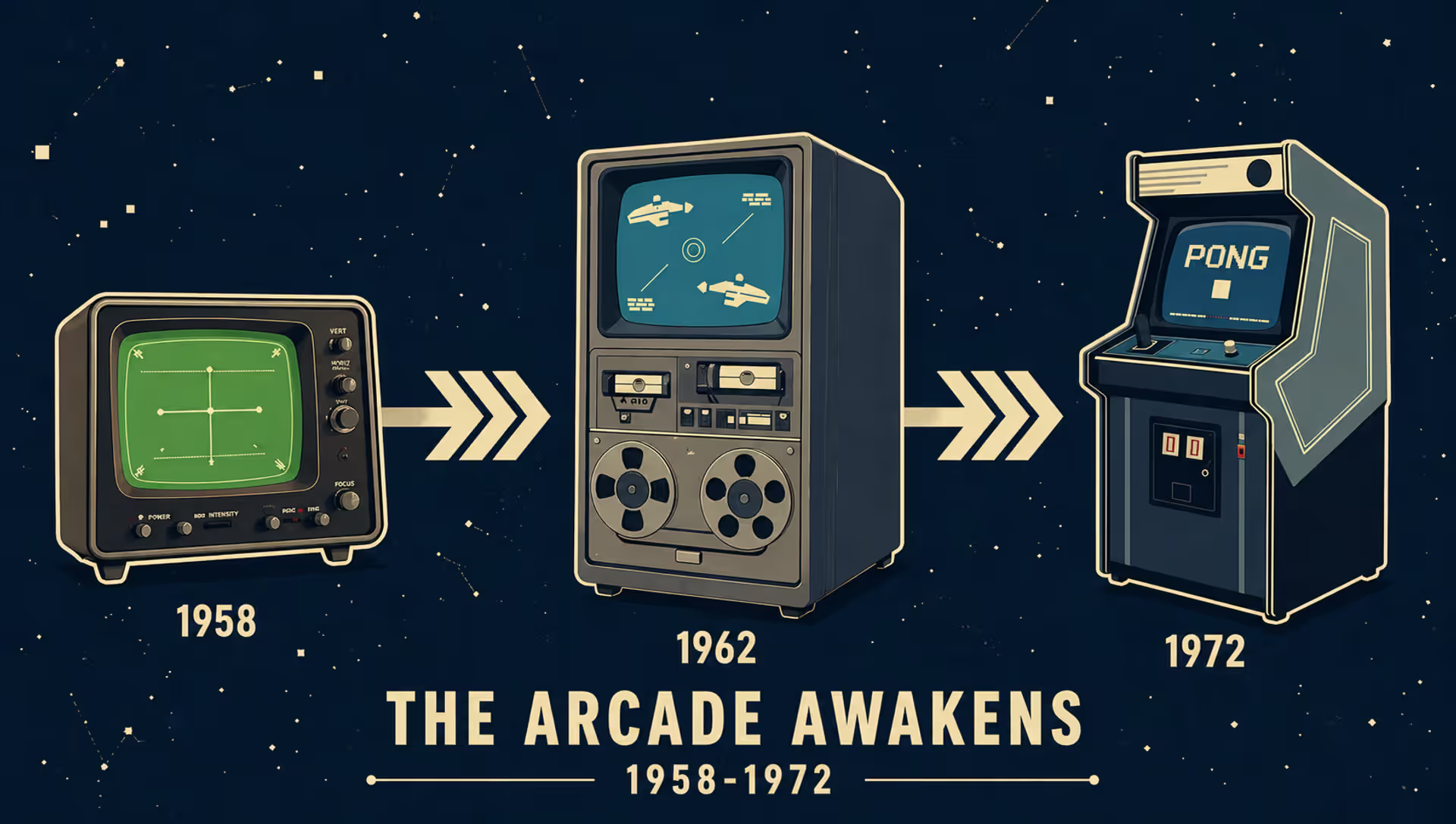
The first video game's creation date depends on your definition. Tennis for Two appeared in 1958, Spacewar! in 1962, and Pong in 1972. Each milestone contributed essential innovations that shaped the gaming industry we know today
Crypto gaming merges blockchain with video games, letting players own assets as NFTs and earn cryptocurrency. Learn how blockchain technology powers games, the rise and fall of play-to-earn, types of crypto games, pros and cons, and whether they're worth your time in 2026
AFK stands for Away From Keyboard—a gaming term indicating a player has stepped away from their device. Understanding AFK meaning in games helps you avoid penalties, respect teammates, and navigate multiplayer etiquette across MOBAs, FPS games, and MMOs
Meta refers to the most effective strategies, characters, and tactics dominating competitive play. Understanding gaming meta isn't just jargon—it's the invisible rulebook shaping how millions play, compete, and win across League of Legends, Valorant, Overwatch, and other competitive titles
The content on this website is provided for general informational and educational purposes only. It is intended to explain concepts related to video games, gaming guides, builds, mobile gaming, multiplayer strategies, and gaming history.
All information on this website, including articles, guides, and examples, is presented for general educational and entertainment purposes. Gameplay outcomes, strategies, and performance may vary depending on player skill, game updates, and platform.
This website does not provide professional advice or guarantee game outcomes, and the information presented should not be used as a substitute for official game documentation or developer guidance.
The website and its authors are not responsible for any errors or omissions, or for any outcomes resulting from decisions made based on the information provided on this website.