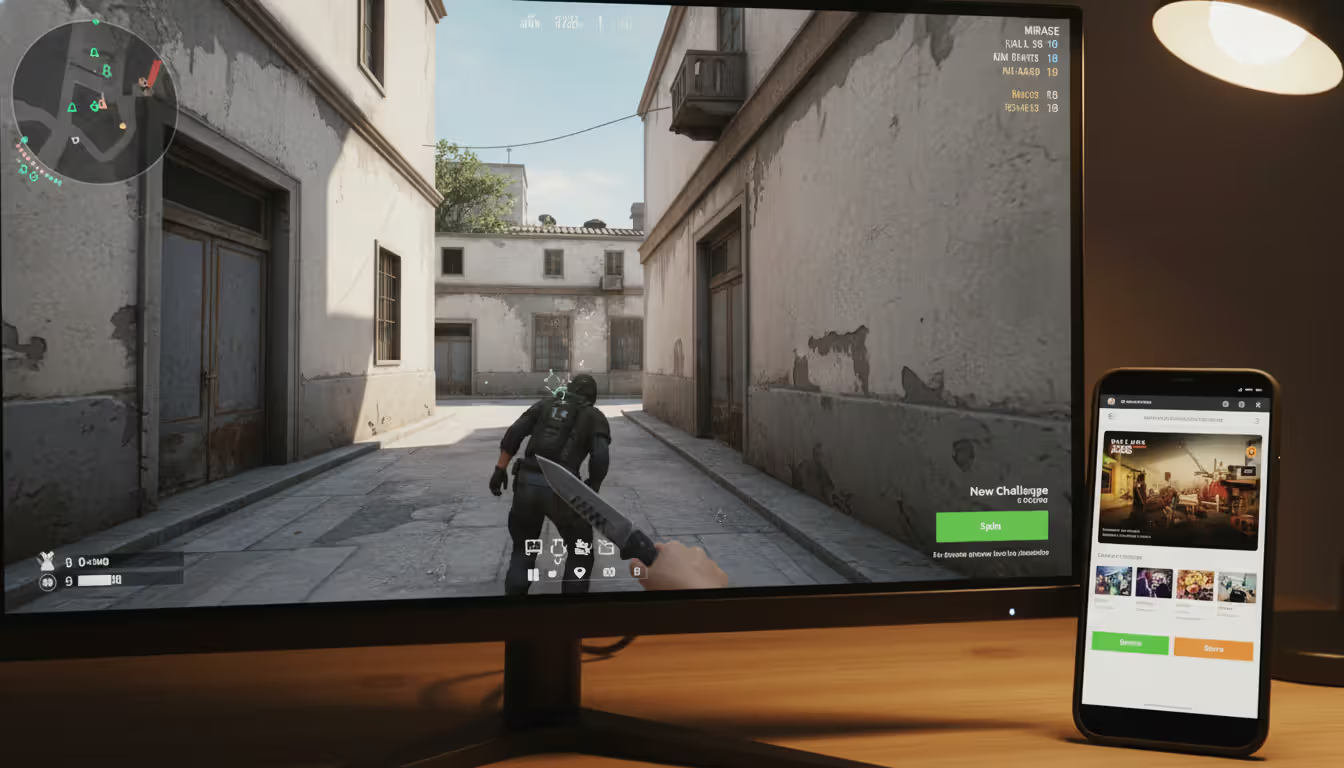
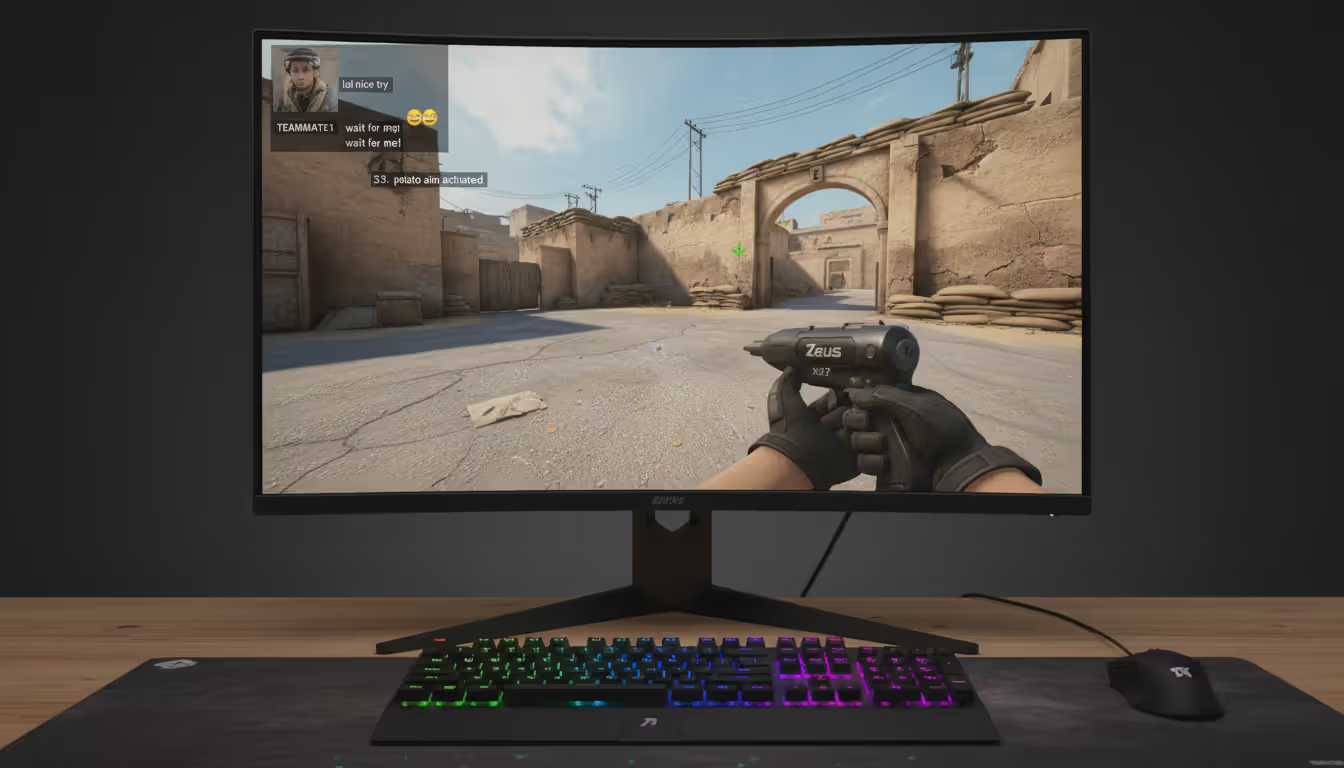
Imagine loading into a CS2 match and learning you can only crouch-walk for the entire round. Or that your team's limited to Zeus tasers against fully-equipped opponents. That's strat roulette—where random generators decide your strategy, turning tryhard matches into beautiful disasters.
The setup's straightforward: you or a teammate pulls up a challenge generator before rounds start. Click the button, get your restriction, announce it to the team. Everyone follows that rule for the next round, no matter how ridiculous. Maybe you're buying weapons with your eyes closed. Maybe all callouts must rhyme. Maybe you're rushing B site while hopping backwards.
Counter-Strike players started sharing challenge lists on Reddit around 2015, mostly as joke posts that gained traction. Someone would type "Round 1: Negev only, Round 2: knife rush mid" and the community ran with it. By 2017, dedicated websites emerged to automate the randomization. Now in 2026, platforms host databases with 800+ challenges, filtering systems by difficulty, and communities submitting new ideas weekly.
How Strat Roulette Changes Your Gameplay Experience
Most competitive shooters reward muscle memory. You learn the same Mirage smokes, hold the same angles, buy the same weapon combos. After your 500th Inferno match, the map becomes background noise while you execute practiced routines.
Strat roulette demolishes that autopilot mode.
CS:GO forums around mid-2015 saw the first organized challenge sharing. Players were burning out on the same meta strategies—"Let's do something stupid" became a common refrain in Discord servers. Early adopters made Google Docs with 20-30 challenges, sharing links in Steam groups. The response? Overwhelming. Turns out, people were desperate for variety after their hundredth standard T-side execute.
Today's random strategy generators have evolved past simple text lists. Sites like StratRoulette.com maintain 800+ challenges with difficulty ratings, success percentages (based on player votes), and compatibility filters. You can exclude challenges requiring full five-stacks if you're running with four. You can filter out high-skill requirements if your team's gold-ranked, not Global Elite.
Why bother with this chaos? Three main groups adopted strat roulette early and stuck with it.
Author: Ethan Rowland;
Source: canelomobile.com
Friend groups use it to remember why gaming's fun. When winning ranks become stressful, reverting to "everyone buys what the player above them requests" brings back the laughter. You're not tilting over lost rounds—you're celebrating that one miraculous Zeus kill that somehow secured the 1v4 clutch.
Content creators built entire channels around it. Search "strat roulette" on YouTube and you'll find thousands of videos, many pulling 100K+ views. The format's foolproof for engagement: skilled players struggle with artificial handicaps while viewers spam "TRY KNIFE ONLY" in chat. NadeKing, WarOwl, and dozens of smaller creators have dedicated series because the variety prevents their content from going stale.
Competitive players discovered unexpected training value. When you can't use your primary weapon, you notice things. Alternative routes become viable. "Useless" utility suddenly has applications. That game sense—reading situations without relying on practiced patterns—transfers back to serious matches. It's why Team Vitality's coach mentioned using modified challenges during practice bootcamps (restricting weapon purchases to force eco-management skills).
The mental reset matters as much as the specific restrictions. Can't take yourself too seriously when the generator demands you compliment enemies in all-chat instead of making callouts.
How to Use a Random Strategy Generator
You don't need downloads or accounts for basic strat roulette. Most generators are just websites—open, click, get your challenge.
Here's how it actually works during matches: your five-stack queues unranked CS2. While waiting, someone (usually whoever suggested trying this) pulls up the generator on their phone. Between rounds, they hit the button and read the result aloud: "Okay boys, 'Silent Treatment'—no voice comms, only text chat." Team acknowledges, round starts, chaos ensues when someone forgets and screams "BEHIND YOU" into their mic.
Timing's everything. Generate between rounds, never mid-game. Your teammates need those 10-15 seconds of freeze time to mentally adjust. Announcing "pistols only" during an active execute doesn't create fun—it creates four people yelling at you.
Assign one person as the "challenge master." They read the full description (some challenges have specific rules buried in the details), clarify edge cases before they become arguments, and confirm everyone understands. Misreading "no primary weapons" as "literally no guns" turns a tough challenge into an impossible one, and someone will blame you when the round's lost.
Pro tip: screenshot or copy the challenge text. Nothing's worse than forgetting the exact wording mid-round when someone asks “wait, can I pick up an enemy AWP or not?”
Popular Strat Roulette Platforms and Tools
Different sites serve different needs. Some prioritize database size, others focus on customization, a few optimize for mobile use during queue times.
Platform Name
Games Supported
Custom Rules Option
Community Size
Mobile-Friendly
StratRoulette.com
CS2, Valorant, R6 Siege
Premium only ($3/mo)
~500K monthly visitors
Works perfectly on phones
ChallengeMode.gg
CS2 exclusively
Free custom builder
~200K monthly visitors
Dedicated iOS/Android app
RandomStrats
15+ games supported
Free with ads
~150K monthly visitors
Responsive but clunky
CS2Roulette.net
CS2 exclusively
Not available
~80K monthly visitors
Desktop experience only
GameChaos.io
Custom game imports
Advanced editor included
~50K monthly visitors
Progressive web app
StratRoulette.com's the granddaddy—operating since 2016 means they've refined challenges through literal millions of attempts. Community voting filters out broken challenges (like the infamous "win without planting" that's technically impossible in certain scenarios). Their database updates weekly with user submissions that passed moderation.
ChallengeMode.gg went all-in on CS2. They track your completion history, offer achievement badges, and rate difficulty based on actual player success rates (not guesses). Their mobile app's genuinely useful—generates challenges during queue without alt-tabbing. Plus the app works offline if you download challenge packs beforehand.
RandomStrats took a different angle: quantity over specialization. Supporting 15+ games means their CS2 selection's smaller, but you can use the same platform for Valorant, Apex, or even Minecraft challenge runs. The unified interface helps if your friend group rotates between games frequently.
Setting Up Custom Challenge Rules
Default pools work fine for most sessions. But custom challenges unlock the real potential once you're comfortable with basics.
Friend groups develop inside jokes that become recurring challenges. My regular stack has "Steve's Revenge" (referencing a terrible 2019 play where our friend Steve rushed A with a decoy and somehow won the round). These personal challenges build group identity better than generic options.
Balancing difficulty separates good customs from frustrating ones. Too easy and they're meaningless—"use any weapon under $5000" barely restricts anything. Too hard and they're demoralizing—"ace with Zeus only" isn't a challenge, it's a guaranteed loss. The sweet spot: challenges that seem barely possible with teamwork and luck.
Make rules specific, not vague. "Use weird weapons" leads to arguments about what qualifies. "Primary weapons must cost under $2000 combined team total" is clear, measurable, and forces coordination. Define what happens if someone breaks a rule accidentally (do you surrender the round? Take a penalty next round?). Spell out whether all five players follow identical restrictions or if you can split roles.
Most platforms with custom builders offer templates. Don't start from scratch—grab "Pistols Only," clone it, then modify one variable. Change it to "Pistols and full utility—must use every grenade before round ends." This incremental approach prevents creating impossible combinations like "knife only while planting opposite site in under 30 seconds."
Test customs in private matches first. What sounds hilarious in Discord might suck during actual gameplay. We spent twenty minutes crafting "Positivity Only" (all comms must be encouraging) only to discover it made shot-calling impossible and wasn't particularly fun. Thirty-second test would've saved us a wasted session.
Author: Ethan Rowland;
Source: canelomobile.com
Types of Gaming Challenge Modes You Can Try
Challenges cluster into recognizable patterns, each testing different skills.
Movement restrictions mess with how you navigate. Crouch-walking the entire round kills rotation speed and makes you vulnerable, but you're nearly silent—suddenly sneaking through Inferno apartments becomes viable when enemies can't hear you. Backwards-only movement disorients players who've memorized maps facing forward (try navigating Dust2 long doors in reverse—it's genuinely disorienting). Jump-restricted runs where you must be airborne to move create absurd timing issues and force weird positioning choices.
Weapon limitations include obvious ones—knife rush, Zeus rush, Negev only—and strategic variants. "Team weapon budget under $5000 total" forces coordination and creative loadouts. "Random weapon assignment" gives each player whatever the generator decides, so your entry fragger might get a sniper rifle while your AWPer gets dual Berettas. "Skin rarity rules" where weapons must match certain skin qualities add economic pressure (good luck when the generator demands StatTrak knives only).
Communication rules fundamentally rewire team coordination in ways you don't expect. "Compliment enemies exclusively" means typing "nice shot buddy!" in all-chat instead of calling out positions. "Everything must rhyme" creates hilarious moments: "Three guys palace, watch your... uh... callous? No wait—" dies. "Foreign language only" works great in multilingual groups. These challenges develop non-verbal coordination because when you can't say "two heaven," you learn to read teammate positioning through game sense alone.
Objective modifications change win conditions entirely. "Bomb site roulette" assigns a random site each round—if you get A, you MUST plant A regardless of map control. "Survivor plants" means only the last player alive can plant the bomb (suddenly staying alive matters more than fragging). "Scenic route" hostage rescues require extracting via the longest possible path.
Economic restrictions introduce financial chaos beyond normal eco rounds. "Full save every round" means literally never buying anything—pistol armor only for the entire match. "Spend exactly $4000" requires precise coordination and calculator apps. "Wealth redistribution" makes the richest player drop weapons for the poorest before rounds start.
Role reversals flip team responsibilities. Your dedicated AWPer must entry frag with MAG-7s. Your support player becomes IGL. Your usual shot-caller can't make any calls—someone else leads and they must follow silently.
The wildest challenges combine categories. "Crouch-only Zeus rushes while all comms must rhyme" is exponentially harder than any single restriction. When it somehow works? You've got a clip you'll watch for years.
Author: Ethan Rowland;
Source: canelomobile.com
Why Gaming Communities Love Random Challenge Runs
The social element explains why strat roulette's lasted over a decade better than any mechanical analysis could.
Shared failure bonds teams harder than shared success. Winning a normal match? Cool, queue next one. Watching your entire squad die attempting a "knife-only A execute" while someone screams "THEY HAVE RIFLES WHY DID WE THINK THIS WOULD WORK"? That's a story you retell for months. Inside jokes emerge organically from spectacular failures.
Content creators figured out strat roulette's engagement potential early. Watching skilled players handicapped by ridiculous restrictions just works for audiences. The format provides built-in variety—every video features different challenges, preventing the staleness that kills gaming channels. Streaming strat roulette typically generates 40-60% more chat activity than standard gameplay according to Twitch analytics breakdowns (viewers spam suggestions, react to failures, celebrate unlikely victories).
Strat roulette strips away the ego from competitive gaming. You can't take yourself seriously when you're trying to win a round using only Zeus tasers. That humility makes you a better teammate in regular matches
— Jake Chen
The skill development surprised competitive players. Random challenges force real-time adaptation—you can't fall back on practiced routines when those routines are banned. Professional athletes train under altered conditions constantly (weighted vests, reaction drills with handicaps) to improve baseline performance. Strat roulette applies identical principles to FPS gaming. That mental flexibility—adjusting strategies when your comfortable patterns fail—directly transfers to clutch situations in serious matches.
Replayability extends a game's lifecycle significantly. Players with 2,000+ hours in CS2 who've "seen everything" rediscover excitement through challenges. Dust2 mid—a space you've crossed literally thousands of times—becomes fresh when you're restricted to backwards bunny-hopping with a sawed-off shotgun.
Community structures emerged around this. Discord servers run challenge leagues with brackets and prizes. Friend groups establish weekly "Roulette Thursdays" as standing traditions (ours has run for 18 months straight). The shared language develops—"remember when we got The Silent Treatment on Overpass?" instantly recalls that specific challenge to anyone who was there.
Common Mistakes When Playing Strat Roulette
Enthusiasm usually overrides common sense. New players make the same predictable mistakes that kill the fun.
Playing strat roulette in ranked matches tops every "don't do this" list. Your solo queue teammates didn't queue competitive to watch you Zeus rush every round. They're trying to rank up. Save experiments for unranked, casual modes, or five-stack customs where everyone agreed beforehand. Forcing strat roulette on unwilling teammates earns justified reports, and trust system bans are real.
Choosing impossibly difficult challenges for your actual skill level just creates frustration. If your team struggles executing basic A splits, "knife-only ace or surrender" isn't challenging—it's just wasting everyone's time. Match difficulty to capabilities. Silver teams should start with mild restrictions (specific weapon types, minor communication tweaks) before attempting "backwards crouch-walk Zeus rush with rhyming comms."
Not establishing rules clearly before starting leads to mid-round arguments. Does "pistols only" include Zeus? Can you pick up enemy weapons after killing them? Can you buy armor? Clarify these edge cases during freeze time, not when someone's already "broken" an unclear rule and the team's arguing instead of playing.
Ignoring team composition causes preventable problems. If one player's significantly less skilled than the other four, challenges requiring equal contribution from everyone will fail repeatedly. Either adjust challenges to accommodate skill gaps (role-specific restrictions) or accept that your Global Elite challenge list won't work for your Silver friend.
Taking losses personally defeats the entire purpose. Strat roulette generates losses by design—that's the point. Getting genuinely frustrated about your win rate during challenge sessions means you're approaching it wrong. The goal's entertainment and skill development, not maintaining your precious W/L ratio.
Forgetting to actually try happens more than you'd expect. Some players treat challenges as excuses to throw rounds intentionally. The fun comes from genuinely attempting impossible strategies with full effort, not giving up instantly. Half-hearted "well we're gonna lose anyway" attempts miss the point. Commit fully even when success seems impossible—that's when unlikely clutches become legendary moments.
Skipping challenges you don't like breaks the entire concept. If you reroll every communication challenge or weapon restriction until you get something comfortable, you're not playing strat roulette—you're just cherry-picking preferred handicaps. Accept what the generator gives you, especially challenges outside your comfort zone. Those uncomfortable ones often create the best stories.
Author: Ethan Rowland;
Source: canelomobile.com
Strat Roulette Beyond CS2: Other Games and Genres
The core concept translates across genres surprisingly well, though implementation changes based on game mechanics.
Valorant adopted strat roulette naturally given its Counter-Strike DNA. Challenges work almost identically, with agent-specific additions creating new categories: "Raze must rocket jump to site entry," "Sage walls off teammates intentionally," "Omen teleports into enemy spawn before executing." The ability-focused gameplay enables challenge types impossible in CS2.
Rainbow Six Siege emphasizes operator restrictions and gadget usage. "Recruit only" remains a classic community challenge. "Opposite operators"—defenders use attacker gadgets when possible and vice versa—creates genuinely interesting scenarios. Destructible environments enable unique challenges: "create all rotation holes before engaging enemies" or "win without using reinforcements." The one-life-per-round format makes challenges higher stakes than CS2's buy-back economy.
League of Legends challenges focus on champion selection and build optimization. "Random champion for each role" is standard, but deeper variants include "all champions start with same letter," "support items only regardless of role," or "no abilities allowed—auto-attacks exclusively for entire game." The 25-40 minute match length means challenges must remain interesting long-term, not just one quick round.
Survival games like Rust or ARK use persistent challenge runs across multiple sessions. "Primitive weapons only" for an entire server wipe (often 7+ days) tests long-term commitment. "Build base in most exposed location possible" creates ongoing tension every time you log in. These work better as self-imposed restrictions since they affect multiple gaming sessions, not single rounds.
RPGs including Elden Ring or Baldur's Gate 3 have dedicated challenge run communities. "No healing items entire playthrough," "starting weapon never upgraded," "pacifist runs with zero kills," and "randomizer mods" all embody strat roulette philosophy. The single-player format shifts focus from team coordination to individual execution and routing optimization.
Battle royales like Apex Legends or Fortnite adapt the concept to their format. "Land hottest drop zone every match," "use only first weapon you find," "no shield items allowed," or "don't enter circle until final zone" all apply strat roulette thinking to the genre's specific mechanics. The RNG-heavy nature of BRs makes challenges feel more natural since you're already dealing with random loot and circle placement.
What works across all these? The core appeal: injecting unpredictability into optimized gameplay. Whether executing CS2 site takes or building LoL team comps, random restrictions force creative problem-solving in the moment.
FAQ: Your Strat Roulette Questions Answered
Is strat roulette allowed in ranked competitive matches?
Technically no rule explicitly prohibits it, but it's strongly discouraged and potentially reportable as griefing depending on how obvious you make it. Ranked modes exist for players trying their hardest to win using optimal strategies. Strat roulette deliberately handicaps your team, wasting your teammates' time and rank points. Reserve challenges for unranked modes, casual playlists, or custom lobbies where everyone agreed beforehand. Most gaming communities (and Valve's own trust factor system) consider using strat roulette in ranked without full five-stack agreement as toxic behavior that'll earn you reports.
Can I create my own custom strat roulette challenges?
Yes—most major platforms include custom builders, and you can always maintain personal lists in Google Docs or Notion. The best customs come from understanding your team's specific dynamics and skill levels. Inside jokes make excellent challenges for friend groups (we have "The Mike Incident" referencing a 2021 accidental teamkill that somehow won the round). Competitive teams create training-focused restrictions targeting weaknesses they've identified in demos. Start with existing challenges as templates and modify single variables instead of building from scratch. Test customs in private matches first—we wasted an entire session on "Positivity Only Comms" before realizing it made shot-calling impossible and wasn't even fun.
What's the difference between strat roulette and challenge modes?
Challenge modes are developer-created official game modes with built-in restrictions enforced by game code (like CS2's Flying Scoutsman or Valorant's Replication). Strat roulette's player-created, uses standard game modes, and relies entirely on self-enforcement through honor system. Challenge modes modify actual rules or mechanics automatically—the game prevents you from breaking them. Strat roulette depends on your commitment. Nothing stops you from breaking "pistols only" except your dedication to the challenge. The randomness also differs: challenge modes have predictable rulesets once you know them, while strat roulette generates different challenges each round unpredictably.
Do professional players ever use strat roulette?
Rarely in its pure form, but many pros incorporate modified versions into training regimens. Team Liquid's CS2 roster mentioned during a 2024 stream using weapon restrictions in practice to improve adaptability under pressure. Some professionals stream pure strat roulette during off-season for content creation and fan engagement (s1mple did a series in late 2023 that pulled 50K+ concurrent viewers). The training value comes from forcing players away from comfortable patterns, similar to how traditional athletes practice with handicaps. However, professional practice time's too valuable for purely random challenges—they use targeted restrictions addressing specific strategic weaknesses identified through demo review.
How do I convince my team to try strat roulette?
Start with mild challenges during warm-up or unranked matches when stakes are nonexistent. Frame it as "just trying something different for one round" rather than committing to full sessions immediately. Show teammates popular strat roulette content so they understand the concept visually (WarOwl's series works well for this). Emphasize that losses genuinely don't matter—the experience and laughs are the actual goal. If someone's resistant, don't force it. One unwilling participant ruins fun for everyone. Often one successful challenge that generates genuine laughter converts skeptics automatically. Consider offering to play several serious matches afterward as compromise ("two challenge rounds, then five normal games").
Are there strat roulette mobile apps?
Yes, several exist now. ChallengeMode.gg offers dedicated mobile apps for both iOS and Android with offline challenge databases you can download. GameChaos.io functions as a progressive web app, working in mobile browsers without requiring installation. Most web-based generators like StratRoulette.com are mobile-responsive now, allowing access from phones or tablets during queue times without issues. Mobile apps provide convenience for generating challenges between rounds without alt-tabbing on PC (which can cause stuttering on lower-end systems). Some apps include team synchronization features letting all five players see identical challenges simultaneously on their devices, preventing the "wait what was the challenge again?" mid-round confusion.
Strat roulette transforms competitive gaming from optimized routines into unpredictable experiments that remind you why gaming's actually fun. Whether you're creating content, developing competitive adaptability, or just want memorable sessions with friends, random strategy generators provide a proven framework for controlled chaos.
The concept's lasted over a decade since its CS:GO origins, which demonstrates its fundamental appeal. Players crave variety, and strat roulette delivers without requiring new maps, developer updates, or DLC purchases. The community-driven nature means challenges evolve alongside games naturally—players constantly create and share restrictions that respond to meta shifts and game updates.
Success requires the right mindset going in. Approach this as entertainment and training, not as a path to rank climbing. Communicate clearly with teammates, match challenge difficulty to actual skill levels, and commit fully to restrictions even when they seem impossible. Memorable moments come from genuine attempts at absurd strategies, not half-hearted efforts or immediate surrenders after reading the challenge.
Start simple: pick one platform, generate one challenge, try it for a single round. You'll know immediately whether random challenge runs fit your gaming preferences. For most players, that first successful knife-only round or backwards-movement clutch creates new appreciation for games they thought they'd completely mastered.
The randomness matters less than the shared experience it creates. Strat roulette succeeds because it forces players to laugh at themselves, adapt to unexpected chaos, and remember gaming's primary purpose—enjoyment, even in competitive environments where everyone's trying to win
The multiplayer gaming landscape continues to evolve at breakneck speed. With studios pushing boundaries in connectivity, cross-platform features, and innovative gameplay mechanics, the next wave of titles promises experiences that go far beyond what we've seen before
Total Battle combines city-building, real-time combat, and alliance warfare across multiple historical eras. This complete guide explains core systems, troop counters, resource management, hero progression, and proven strategies to help new players build competitive castles and thrive in alliance warfare
Shooter games span diverse subgenres from tactical simulations to fast-paced battle royales. This guide explains first-person vs third-person shooters, major game types, core mechanics, and how to choose games matching your skill level and preferences
Gaming from your living room has evolved into a vibrant social experience connecting millions worldwide. Whether coordinating raids with teammates across continents or enjoying puzzle games during lunch breaks, optimizing your home setup and choosing the right games makes all the difference
The content on this website is provided for general informational and educational purposes only. It is intended to explain concepts related to video games, gaming guides, builds, mobile gaming, multiplayer strategies, and gaming history.
All information on this website, including articles, guides, and examples, is presented for general educational and entertainment purposes. Gameplay outcomes, strategies, and performance may vary depending on player skill, game updates, and platform.
This website does not provide professional advice or guarantee game outcomes, and the information presented should not be used as a substitute for official game documentation or developer guidance.
The website and its authors are not responsible for any errors or omissions, or for any outcomes resulting from decisions made based on the information provided on this website.